
eConsent, telehealth visits, wearables, and remote data capture have made it possible to move more clinical trial activities outside traditional research sites. For participants, that can mean fewer trips and a trial that fits more easily into everyday life.
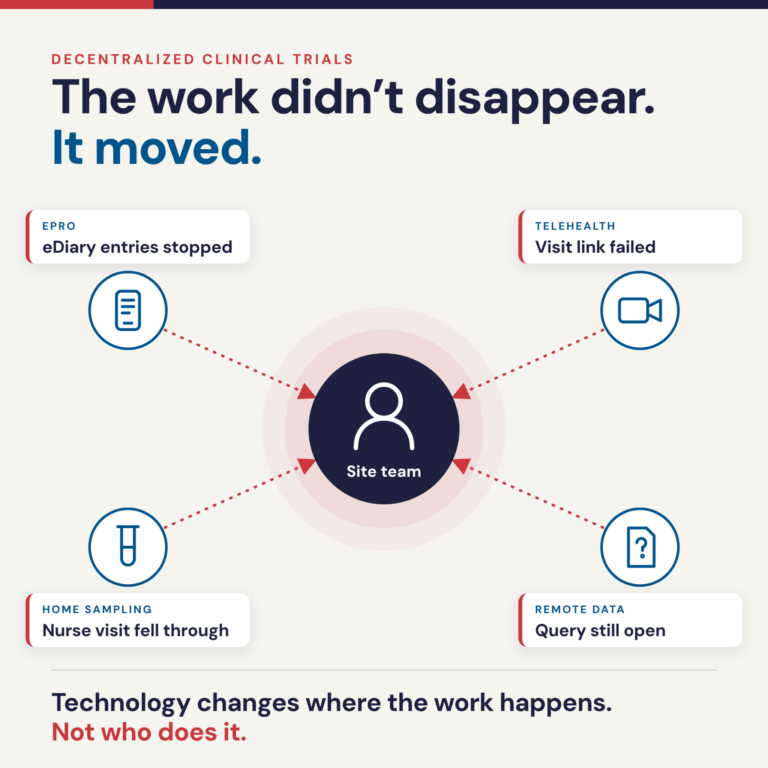
But the work didn’t disappear. It moved. And in some studies, it grew.
For sponsors and CROs, the question is a practical one: Does the staffing plan reflect where the work actually happens?
Every Remote Activity Still Needs Someone Responsible
Consider a hybrid study with remote visits, electronic patient-reported outcomes (ePRO), home sample collection and eConsent.
Each activity creates operational responsibilities that someone needs to own.
- A participant cannot get an eDiary to sync. Who helps resolve the problem?
- Entries stop for a week. Who identifies the missing data and follows up?
- A home visit falls through. Who coordinates rescheduling before the protocol window closes?
- A data query remains open. Who works with the appropriate site personnel to resolve it?
These responsibilities may be distributed among site staff, centralized teams and external service providers.
When ownership is unclear or sufficient capacity has not been planned, the additional work can fall to already stretched research coordinators.
That’s how a model designed to reduce participant burden can inadvertently increase the workload at the site.
What Does the Research Tell Us?
A systematic review by Rogers and colleagues, published in the British Journal of Clinical Pharmacology (2022), examined decentralized trial methods and identified four recurring considerations: value, burden, safety and equity.
The review highlighted potential advantages of decentralized approaches, but also identified operational challenges, including additional staff workload and the need to support participants using unfamiliar technologies.
Importantly, the researchers found that evidence remains insufficient to establish which decentralized methods consistently improve recruitment, retention or costs.
A separate systematic scoping review by Gamble and colleagues, published in the Journal of Medical Internet Research (2023), examined strategies used to support clinical trial retention. The findings highlighted the relevance of communication, participant motivation, convenience and interpersonal connection.
Together, these studies reinforce an important consideration: Technology may change how participants interact with a study, but human support remains an important part of trial design and execution.
Matching People to the Work
Not every decentralized activity requires another full-time CRC, and not every task requires someone physically present at the research site.
Depending on the protocol and site requirements, remote professionals can support specific activities:
- Patient Navigators can assist with scheduling, reminders, technology orientation and coordination of approved participant activities.
- Clinical Data Coordinators can support authorized data entry, query resolution and documentation reconciliation.
- Remote CRCs can assist with visit preparation, scheduling, documentation and follow-up activities within their assigned responsibilities.
The right solution might be a dedicated professional for several hours a week, rather than an additional full-time position.
The important distinction is that remote support does not replace investigator oversight. The site remains responsible for appropriate delegation, supervision, clinical decisions and participant safety.
This is consistent with recommendations published by the Clinical Trials Transformation Initiative on the legal, regulatory and practical considerations of decentralized clinical trials.
Start With the Work, Not the Staffing Title
At RapidTrials, we work with sponsors and CROs to identify qualified independent clinical research professionals for specific site requirements, whether the need is remote, onsite or hybrid.
Our approach begins with understanding the work the protocol requires and the capacity already available at the site.
Before implementing a decentralized or hybrid study, I would encourage clinical operations teams to ask four questions:
- Who is responsible for each remote activity?
- Does the site have sufficient capacity to manage the additional workload?
- Which responsibilities require clinical expertise, and which can be supported by qualified operational personnel?
- Could targeted, part-time support address a capacity gap more effectively than adding another full-time position?
The answer will not always be more staffing. Sometimes it will be clearer responsibilities, better processes or a different allocation of existing resources.
The goal is not to put a person behind every technology. It is to make sure the work created by that technology has a qualified person responsible for carrying it out.
Decentralized trials give us more options for how and where research is conducted. Their success still depends on thoughtful operational planning, appropriate oversight and having the right people available to do the work.