Decentralized clinical trials are often positioned as a technology-enabled way to expand access, reduce travel, and bring clinical research closer to participants.
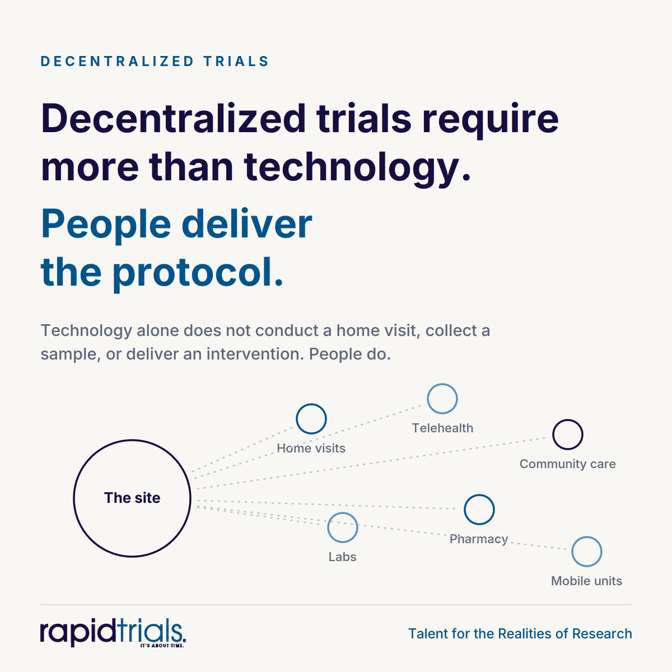
That promise is real. But technology alone does not conduct a home visit, assess a participant, collect and process a sample, deliver a nutrition intervention, perform a functional assessment, reconcile medication, or help a participant complete a demanding protocol.
People do.
In decentralized and hybrid trials, protocol activities may be delivered across participants’ homes, telehealth platforms, community healthcare settings, local laboratories, pharmacies, mobile research units, and traditional investigative sites.
This changes not only how a study is managed, but also who performs the work and where that work occurs.
For clinical operations and patient recruitment leaders, the central question is:
Does the study have qualified, protocol-trained professionals who can deliver required services consistently wherever participants are located?
Effective DCT staffing must address both sides of the operating model:
- The professionals performing participant-facing and protocol-specific activities
- The personnel coordinating, documenting, and overseeing those activities across sites, vendors, and systems
Both are necessary for reliable decentralized trial execution.
Decentralization redistributes the work
In a traditional site-based trial, many clinical, administrative, and participant-support activities are concentrated within the investigative site.
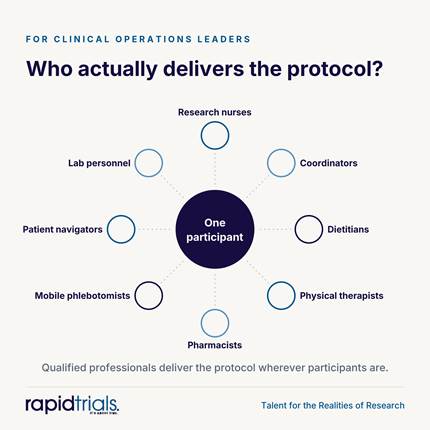
Research nurses, clinical research coordinators, investigators, pharmacists, laboratory personnel, dietitians, physical therapists, and other specialists may work within a familiar institutional infrastructure.
In a decentralized model, those same responsibilities may be distributed across multiple locations and providers.
A participant may complete a telehealth visit with a research nurse, receive nutrition counseling from a registered dietitian, undergo a functional assessment with a physical therapist, have blood collected by a mobile healthcare professional, receive study medication through a central pharmacy, and enter outcomes through a study application.
The investigative site may remain responsible for oversight, but the protocol itself is being delivered through a broader network of qualified professionals.
The operational burden has not disappeared. The work has moved.
The professionals who deliver decentralized trial activities
DCT staffing should not be viewed solely as adding coordinators to manage vendors or monitor remote workflows. Depending on the protocol, sponsors and CROs may need a multidisciplinary workforce to perform study activities directly.
Research nurses
Research nurses may conduct home, community-based, or virtual visits that require clinical training and judgment. Their responsibilities may include protocol-defined clinical assessments, vital signs and symptom evaluation, collecting and processing biological samples, supporting investigational product administration, reinforcing adverse-event reporting requirements, assessing and escalating participant concerns, educating participants and caregivers, documenting findings for investigator review, and coordinating with local healthcare providers when needed.
Research nurses can extend clinical trial delivery beyond the investigative site while maintaining appropriate clinical standards and escalation pathways.
Clinical research coordinators
Clinical research coordinators may support both participants and sites throughout the decentralized trial journey: scheduling remote, home-based, and local-provider visits; preparing participants for upcoming assessments; coordinating laboratory kits, supplies, couriers, and shipments; supporting electronic diary and device onboarding; monitoring completion of protocol-required activities; following up on missing documentation; reconciling information between vendors and the EDC; supporting source documentation and essential-file maintenance; identifying potential deviations and escalating concerns; and helping the investigator maintain visibility across decentralized activities.
The coordinator often serves as the operational connection among the participant, investigative site, mobile personnel, vendors, and central study team.
Registered dietitians
Dietary interventions are increasingly incorporated into metabolic, obesity, cardiovascular, gastrointestinal, renal, and other clinical development programs. Registered dietitians may conduct protocol-required nutrition assessments, deliver virtual dietary counseling, develop or reinforce study-specific nutrition plans, review food records and participant-reported intake, assess adherence to dietary requirements, document counseling encounters, identify barriers affecting intervention compliance, and escalate clinical concerns to the investigator or study team.
A dietitian delivering a standardized behavioral or nutritional intervention is not simply providing general wellness support. The dietitian may be performing a defined component of the protocol that requires consistency, training, documentation, and quality oversight.
Physical and occupational therapists
Physical therapists and occupational therapists may be needed in studies involving mobility, neuromuscular disease, rehabilitation, aging, pediatrics, rare disease, pain, or functional endpoints. They may perform standardized mobility and functional assessments; strength, balance, gait, or endurance evaluations; remote or in-home rehabilitation interventions; participant training on exercises or assistive equipment; video-based assessments; functional outcome documentation; and monitoring for changes that require clinical escalation.
The reliability of these assessments depends on protocol training, consistent technique, participant safety, and appropriate documentation. They should not be treated as interchangeable general healthcare services.
Pharmacists and investigational product professionals
Pharmacists may support decentralized drug delivery and investigational product management through participant education on administration and storage, medication reconciliation, accountability reviews, temperature-excursion assessment, direct-to-participant shipment coordination, review of adherence concerns, documentation of dispensing and returns, and communication with the investigator and central pharmacy.
Their involvement can be especially important when investigational products are administered or managed outside the traditional site pharmacy.
Mobile healthcare professionals and laboratory personnel
Phlebotomists, laboratory technicians, mobile nurses, and other qualified healthcare professionals may perform home or community-based services such as blood collection; sample preparation and centrifugation; processing, packaging, and shipment; ECGs and other protocol-defined procedures; vital-sign collection; collection of pharmacokinetic or biomarker samples; documentation of collection conditions and timing; and management of sample discrepancies or recollection requirements.
These activities can materially affect endpoint quality and participant safety. They require more than geographic availability. They require protocol-specific competency and reliable execution.
Patient navigators and participant-support professionals
Patient navigators can help participants manage the practical demands of a decentralized trial: explaining the participant journey in accessible terms, coordinating reminders and appointments, helping participants navigate multiple vendors and platforms, addressing transportation, technology, scheduling, or caregiver barriers, supporting retention and continued engagement, identifying early signs of participant burden, and directing clinical concerns to appropriately qualified personnel.
Patient navigators do not replace clinical staff. They help reduce the nonclinical friction that can make continued participation difficult.
Performing the work is only half of the model
A multidisciplinary decentralized workforce also requires an operating structure that connects the people performing the activities with the investigator, site, sponsor, CRO, and technology platforms. Without clear coordination, decentralized activities can become fragmented.
For example:
- A nurse may complete a home visit, but the documentation may not reach the site promptly.
- A dietitian may identify nonadherence, but the escalation pathway may be unclear.
- A physical therapist may observe a meaningful decline, but the finding may not be communicated to the investigator.
- A mobile phlebotomist may collect the sample, but shipment timing or processing conditions may not be reconciled.
- A participant may report a symptom to a navigator who is not trained or authorized to assess it clinically.
This is why DCT staffing requires both service delivery and operational integration.
The professionals doing the work must understand their protocol-defined responsibilities, the limits of their role, documentation requirements, safety-reporting expectations, escalation pathways, investigator-oversight requirements, and applicable privacy and data-security obligations.
The study team must also know when each activity was performed, whether it was completed correctly, what issues occurred, and whether follow-up is required.
Technology connects the trial. People deliver the protocol.
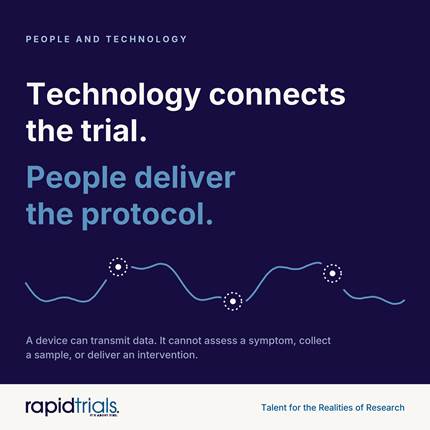
Digital health technologies can support more frequent data collection and reduce dependence on periodic site visits. However, technology does not independently conduct assessments, deliver interventions, collect samples, educate participants, or respond to clinical concerns.
A wearable device may stop transmitting. A participant may misunderstand an electronic diary question. A home sample may be collected outside the required window. A medication shipment may be delayed. A telehealth visit may reveal a potential safety concern.
Qualified nurses, coordinators, dietitians, physical therapists, pharmacists, laboratory professionals, and other trained personnel are needed to perform protocol-required activities and determine what should happen when an issue arises. They may conduct clinical or functional assessments, deliver protocol-defined interventions, troubleshoot participant-facing technologies, investigate missing or inconsistent data, repeat participant training, arrange replacement equipment or repeat procedures, document and escalate potential protocol deviations, assess whether an issue may affect participant safety, and coordinate corrective action across sites and vendors.
Technology connects participants, data, sites, and study teams. Qualified professionals deliver the protocol and provide the judgment, communication, and intervention that technology cannot provide independently.
Participant access is meaningful only when services can reach the participant
Decentralized elements may allow a study to recruit participants who live farther from major research centers or who cannot travel frequently. But expanding the geographic recruitment radius is only valuable when the study can reliably deliver the protocol within that expanded area.
Before opening recruitment to a broader population, sponsors and CROs should determine whether they can provide credentialed nurses for home visits, qualified therapists for standardized assessments, dietitians trained on the study intervention, mobile phlebotomy and sample-processing services, pharmacy support within required jurisdictions, coordinators who can work across time zones and systems, language-appropriate participant support, coverage in rural or underserved areas, and backup resources when the primary professional is unavailable.
Recruitment strategy and delivery capacity should be evaluated together. Otherwise, a decentralized design may increase initial access while creating downstream difficulties in scheduling, service availability, participant retention, and protocol compliance.
Protocol-specific training matters
A professional’s healthcare credentials alone may not be sufficient.
A nurse experienced in home healthcare may still require training on clinical research documentation, adverse-event reporting, investigational product requirements, and protocol-defined visit procedures. A physical therapist may need training and certification on a specific functional outcome measure. A dietitian may need to deliver a standardized intervention without introducing advice that falls outside the protocol. A phlebotomist may need precise training on timed collections, specialized tubes, processing windows, centrifugation, temperature controls, and shipping requirements.
Sponsors and CROs should therefore assess clinical credentials and licensure, research experience, therapeutic-area experience, protocol-specific competency, experience with the required technology, documentation capabilities, geographic coverage, language capabilities, availability and backup coverage, and ability to work within investigator-oversight requirements.
The goal is not simply to find an available professional. It is to deploy someone qualified to perform the assigned protocol activities correctly.
Flexible staffing can match capacity to participant demand
The need for decentralized personnel is rarely constant throughout a study. Demand may increase during site activation, enrollment surges, participant onboarding, dose escalation, introduction of a new protocol procedure, seasonal recruitment periods, protocol amendments, follow-up-intensive study phases, and database cleaning and closeout.
A flexible or fractional staffing model can allow sponsors and CROs to add specific capabilities when and where they are required. For example, a study may need research nurses for scheduled home visits, dietitians for a defined series of telehealth sessions, physical therapists for milestone-based assessments, coordinators for several hours per week at high-volume sites, mobile phlebotomists based on participant location, navigators during enrollment and early treatment, and data coordinators during reconciliation and database-cleaning periods.
This is not simply about reducing fixed costs. It is about aligning professional capacity with protocol demand, participant geography, enrollment volume, and study phase.
Questions clinical operations leaders should ask
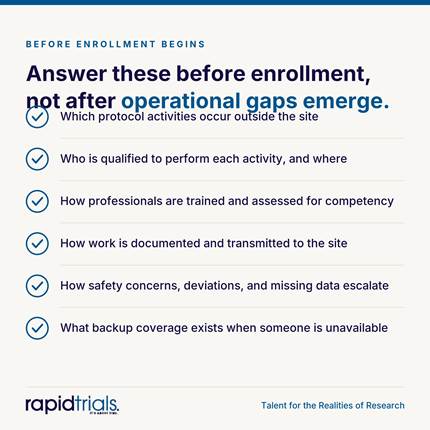
When planning a decentralized or hybrid trial, sponsors and CROs should consider:
- Which protocol activities will occur outside the investigative site?
- Which professionals are qualified to perform each activity?
- Where must those professionals be licensed or credentialed?
- How will they be trained and assessed for competency?
- How will participants schedule and access their services?
- How will work be documented and transmitted to the site?
- Who reviews the information and confirms that the activity was completed correctly?
- How are safety concerns, deviations, and missing data escalated?
- What backup coverage is available?
- Can the staffing model expand as enrollment grows or geography changes?
These questions should be addressed before enrollment begins, not after operational gaps emerge.
DCT staffing is both a workforce strategy and a delivery model
The decision is not simply whether a decentralized trial needs more operational oversight. The study needs qualified people to perform the decentralized work.
It may require nurses conducting home visits, coordinators connecting participants with study services, dietitians delivering remote interventions, physical therapists administering functional assessments, pharmacists supporting investigational product management, phlebotomists collecting samples, and navigators helping participants remain engaged. It also requires the infrastructure to train, schedule, support, document, and oversee those professionals.
The credible value of DCT staffing is not that adding people will eliminate every operational risk. It is that a fit-for-purpose, protocol-trained workforce can make it possible to deliver study activities consistently beyond the traditional research site.
In decentralized clinical trials, technology connects the study, but qualified professionals deliver the protocol.