The Workforce Model Has to Change
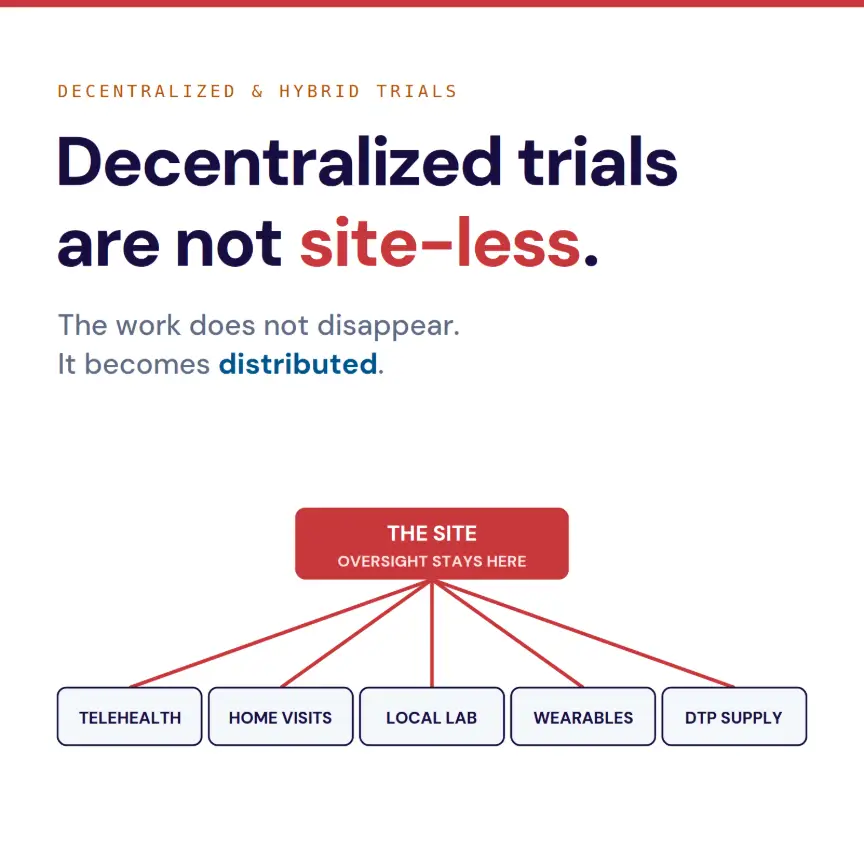
Every new setting a trial touches is another handoff that must be staffed, coordinated and overseen.
Decentralized clinical trials were never simply a technology shift. They are an operational shift.
When trial activities move beyond the traditional investigative site into participants’ homes, telehealth visits, local healthcare settings and digital platforms, the work does not disappear. It becomes distributed. And that changes the staffing equation.
FDA guidance recognizes decentralized elements such as telehealth, in-home visits and activities performed by local healthcare providers. ICH E6(R3) similarly reflects the growing use of technology, service providers and decentralized approaches while continuing to emphasize qualified personnel, appropriate delegation and investigator oversight.
For Sponsors and CROs, the implication is important:
A decentralized trial requires an operating model designed for distributed execution, not simply a traditional site model with technology layered on top.
Decentralization Redistributes the Work
When participants no longer complete every trial activity at the investigative site, a study may involve telehealth visits, in-home clinical procedures, local laboratory testing, direct-to-participant shipments, wearable devices, electronic patient-reported outcomes and remote participant education.
Each element may reduce the burden of traveling to a traditional site. But each also creates another operational handoff that must be coordinated.
Participants still need to be prepared. Visit windows still need to be managed. Specimens need to move. Missing information needs follow-up. Device issues need resolution. Safety concerns need escalation. Data generated outside the site still need to reach the appropriate study personnel.
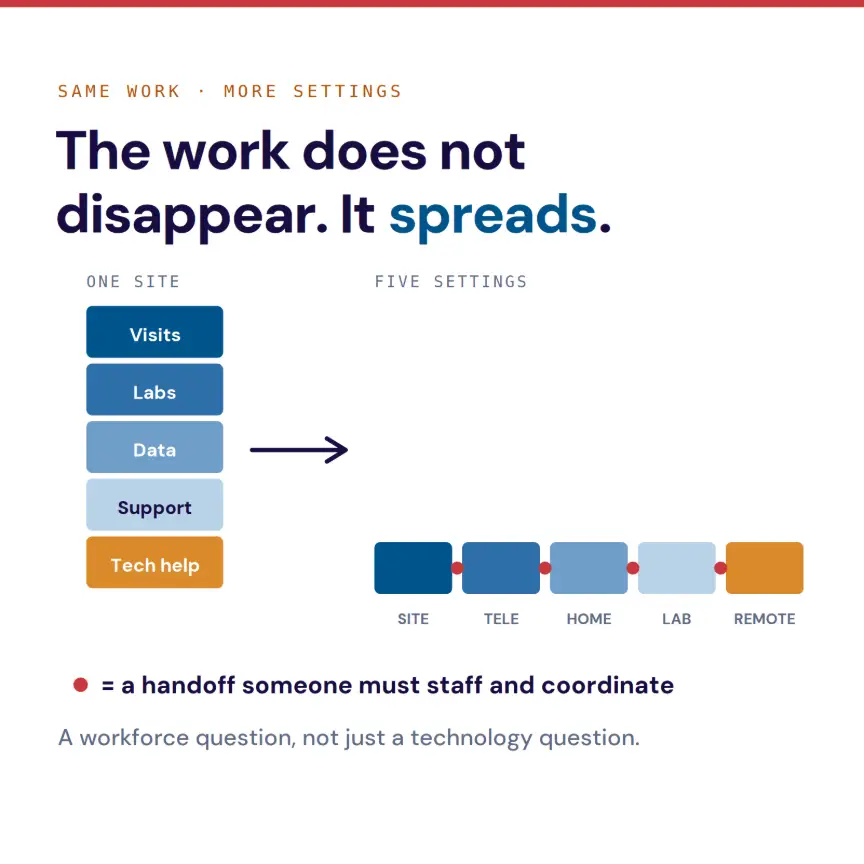
Those are workforce questions as much as technology questions.
The Investigative Site Remains Central
Decentralization does not decentralize accountability. Investigators retain responsibility for appropriate oversight of delegated trial activities, including activities performed outside the traditional site setting.
The objective of decentralized staffing therefore should not be to bypass the investigative site. It should be to extend the site’s operational capacity while maintaining clear responsibilities, communication pathways and escalation processes.
Hybrid Trials Create a Different Capacity Problem
Many trials described as decentralized are actually hybrid. Some protocol activities occur at the investigative site. Others take place remotely, in the participant’s home or through local healthcare providers.
That creates a workload pattern very different from a conventional site-based study. A participant may move repeatedly between physical and virtual workflows over the course of a trial.
For Clinical Operations teams, workforce planning should begin by determining where each protocol activity occurs, who is qualified to perform it and how the resulting information moves back into the study workflow.
Different therapeutic areas can create very different requirements. An oncology study, rare-disease program, neurological trial or cell and gene therapy study may each involve a distinct combination of complex eligibility assessment, patient education, specialty procedures, laboratory logistics and longitudinal follow-up. The staffing model should reflect those differences.
A research nurse may be needed for an in-home procedure. A CRC may coordinate visits and documentation. A clinical data coordinator may support data entry and query resolution. A patient navigator may help participants manage increasingly complex logistical requirements.
The objective is not to build a larger workforce. It is to build a workforce aligned with the protocol.
Technology Does Not Eliminate Participant Support
Digital tools can make participation more convenient and allow study data to be collected remotely. They can also introduce another point of friction.
Participants may need help setting up devices, understanding when and how to use them, completing electronic assessments or resolving technical problems. A study may look more convenient from an operational-design perspective while still becoming more complicated for the participant.
Technology can enable decentralized research, but it cannot replace the human support required to help participants successfully navigate it.
Recruitment and Decentralization Need to Be Planned Together
Decentralized approaches may broaden patient access by reducing some of the geographic and logistical barriers to participation. But greater reach does not automatically produce enrollment or retention.
Someone still needs to respond to interested patients, review records, assess eligibility, coordinate screening, facilitate remote activities and maintain engagement over time. This creates an important question for Patient Recruitment and Site Engagement teams: Can we reach more patients, and do we have the operational infrastructure to support them once we do?
Without that capacity, decentralization can simply move the bottleneck from patient access to trial execution.
The Resource Model Should Follow the Work
Traditional clinical trial staffing frequently starts with roles and headcount. How many CRCs are needed? How many nurses? How many hours per week?
For decentralized and hybrid trials, there is a better starting point:
- Start with the protocol.
- Map the activities.
- Determine where they occur.
- Identify who is qualified to perform them.
- Estimate when the workload occurs.
- Then assess what capacity already exists and where additional resources are required.
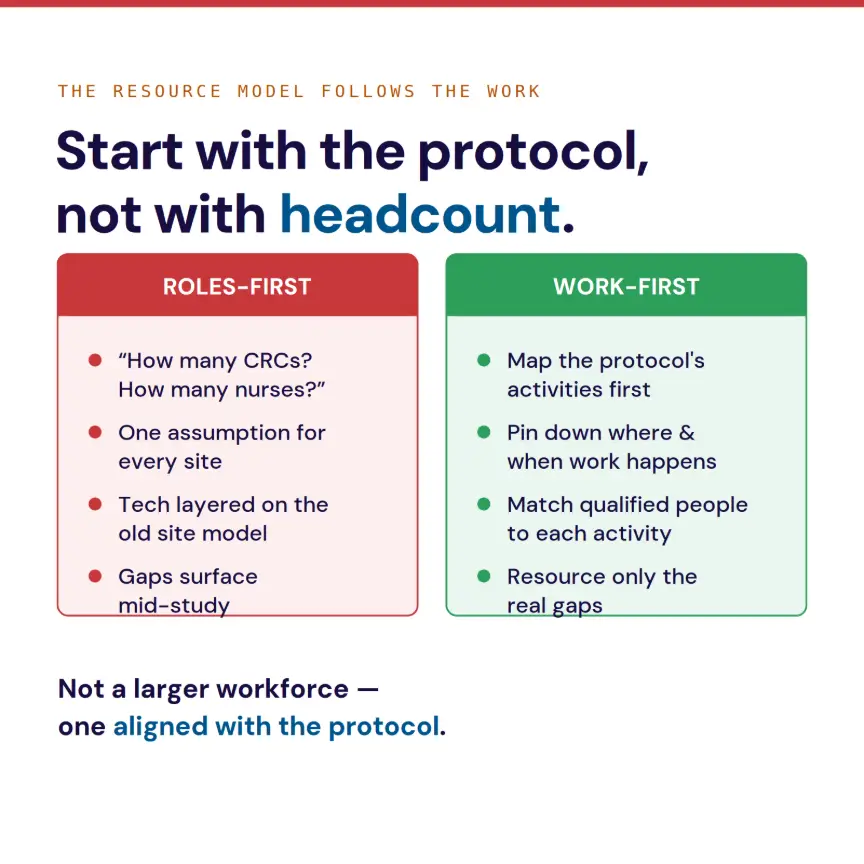
The resource model should follow the work rather than applying the same staffing assumption across every site.
One site may need substantial participant-navigation support but little additional clinical capacity. Another may have sufficient coordinator resources but require research-nurse coverage for home-based procedures. A third may need temporary data support during an intensive enrollment period.
Decentralization Makes Workforce Design More Important, Not Less
The promise of decentralized clinical trials is compelling: bring appropriate elements of the trial closer to participants rather than requiring every activity to occur at a conventional investigative site.
But doing so creates more interfaces among participants, investigators, site personnel, healthcare providers, technology platforms and service providers. Those interfaces need qualified people, clearly defined responsibilities and appropriate oversight.
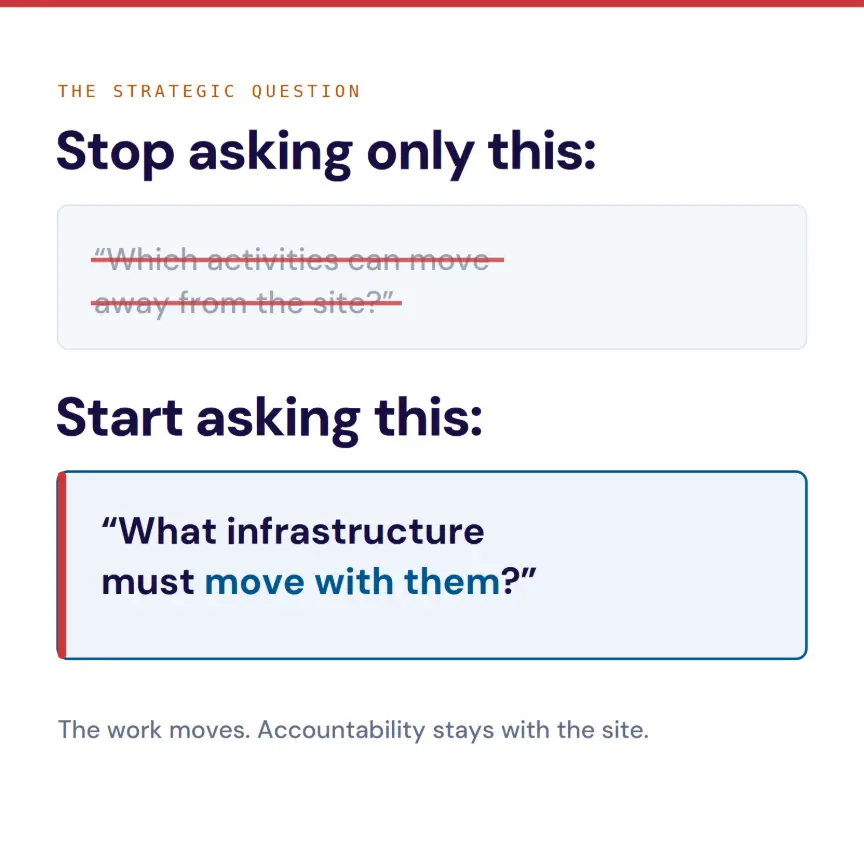
For Sponsors and CROs, the strategic question is therefore not simply which trial activities can move away from the site. It is what operational infrastructure needs to move with them.
The site is not removed from the model — it becomes the hub the model must support.
At RapidTrials, we use a protocol-to-workload approach to identify where site and participant-facing capacity is likely to be needed before operational constraints become visible. The goal is not simply to add staff, but to align the right clinical research capabilities with the work the protocol actually generates.
That is where decentralized and hybrid trial workforce planning should begin.