
Every site runs the same protocol. No two sites run it the same way.
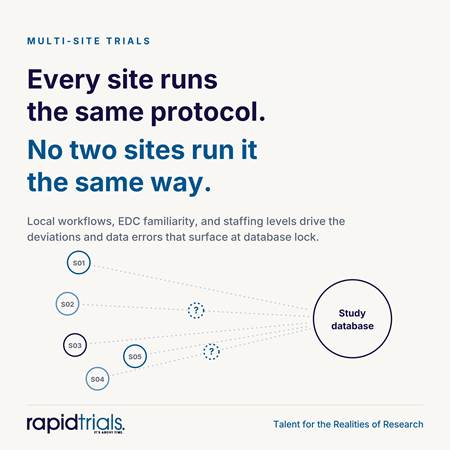
A multi-site trial rarely struggles because the protocol was poorly designed. It struggles because the protocol is executed differently at every location.
Each additional site brings its own workflows, its own EDC learning curve, its own staffing constraints, and its own interpretation of protocol definitions. Individually, these are small differences. Across a network, they compound into transcription errors, delayed entries, and protocol deviations that stay invisible until they surface where they are most expensive: as query backlogs, cleaning delays, and database lock slippage.
Why multi-site operations accelerate data errors
The most common error drivers are operational, not scientific:
- Inconsistent data entry practices, when site staff have limited training on the specific EDC platform or interpret protocol definitions differently
- Delayed adverse event reporting, when coordinators split time between clinical care and trial documentation, or when safety workflows are unclear
- Higher deviation rates, driven by complex eligibility criteria, enrollment pressure, and inadequate training on critical protocol steps
The literature points to the same levers repeatedly: targeted education, clearer protocols, and stronger monitoring reduce staff-driven deviations. In other words, the fix is not more technology at the site. It is more capable, better trained execution at the site.
What embedded, protocol-trained CRCs change
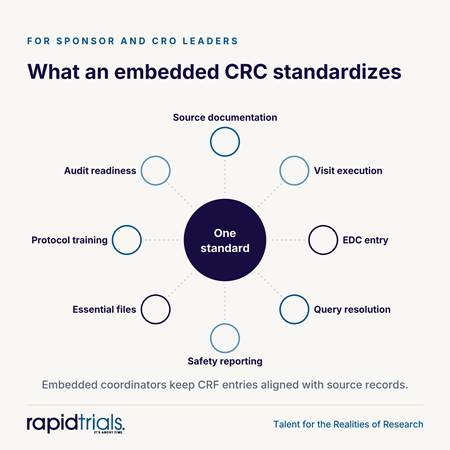
Well-trained clinical research coordinators sit at the center of data quality. They create, collect, and organize trial documentation, keep case report form entries aligned with original medical records, and maintain data integrity across the trial lifecycle.
Embedding dedicated, competency-matched coordinators at active sites, rather than relying on ad hoc or purely transactional support, enables three things that centralized oversight cannot deliver on its own:
- Real-time source data verification, which helps catch mismatches between medical records and electronic submissions before they propagate through the study database
Uniform execution of visit procedures across sites and regions, which reduces variability in the final dataset
Faster query resolution, which prevents the backlogs that delay database cleaning and lock
Accountability still sits where regulation places it: the principal investigator is ultimately responsible for data integrity. But that responsibility is delivered through coordinators who assure timely, accurate source documentation and data entry on the protocol schedule. The question for sponsors and CROs is whether every site in the network actually has that capability, or whether some are absorbing the protocol on top of an already full clinical workload.
When the protocol demands clinical depth, add research nurses
Some protocols require more than coordination: complex sample handling, infusion administration, or detailed physiological assessments. In these settings, dedicated research nurses strengthen both patient safety and data quality.
Research nurses contribute by ensuring investigational product administration follows the protocol schedule and documentation requirements, detecting subtle changes in patient status and documenting potential adverse events with clinical precision, and maintaining accurate drug logs and specimen tracking that stand up during audits and inspections.
Large-dataset studies in nursing indicate that staffing factors correlate with patient outcomes. The same principle holds in research settings: skilled clinical resources support both care quality and data fidelity in complex protocols.
Capacity should follow the study, not the org chart
Staffing demand in a multi-site trial is not constant. Startup, enrollment surges, protocol amendments, and closeout each create concentrated workload at specific sites for defined periods.
Scalable staffing models let sponsors and CROs direct support to where the pressure actually is:
Surge support to sites falling behind on data entry timelines
Temporary expert staff to accelerate startup and closeout tasks
Variable capacity in place of fixed infrastructure where needs fluctuate
The value case here should be made carefully. The primary benefit is not headcount cost. It is control: the ability to respond within days when a site becomes a data quality hot spot, rather than discovering the problem at interim analysis. Any cost-efficiency claim should be validated against actual utilization data.
What this protects: database lock and inspection readiness
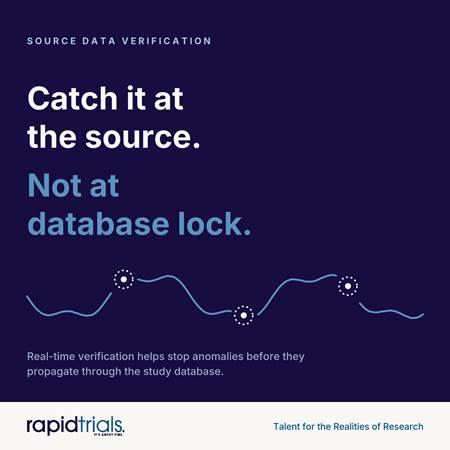
The end goal is a clean, timely database lock and a network that can withstand an unannounced inspection at any site.
Ongoing verification at the source minimizes the late discovery of systematic errors, which is when they are most expensive to correct. Complete, legible, contemporaneous source documents keep sites inspection-ready rather than inspection-scrambling. And stable, adequately resourced site teams reduce coordinator burnout, which protects data quality over the life of the study rather than just at its milestones.
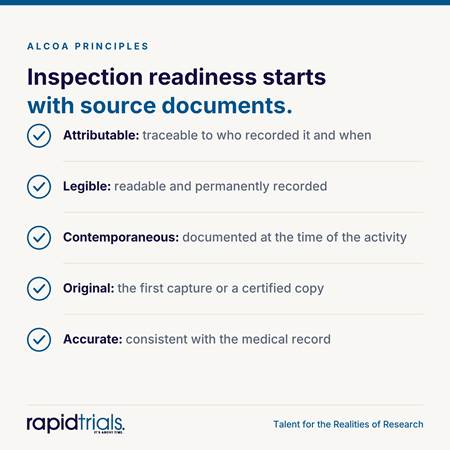
Regulators will judge source documentation against ALCOA: attributable, legible, contemporaneous, original, and accurate. Every one of those five properties is produced or destroyed at the site, visit by visit, entry by entry. That is why staffing is a data quality strategy, not an administrative one.
About RapidTrials
RapidTrials embeds fully vetted, protocol-ready clinical research coordinators and research nurses directly at investigator sites. Our site augmentation framework is built to maintain uniform execution standards across complex, multi-site study environments: standardized visit procedures, disciplined source documentation, and query resolution that keeps pace with enrollment.
We do not claim that staffing eliminates data errors. We commit to reducing the variability that produces them, and to giving sponsors and CROs a site network they can defend at database lock and at inspection.